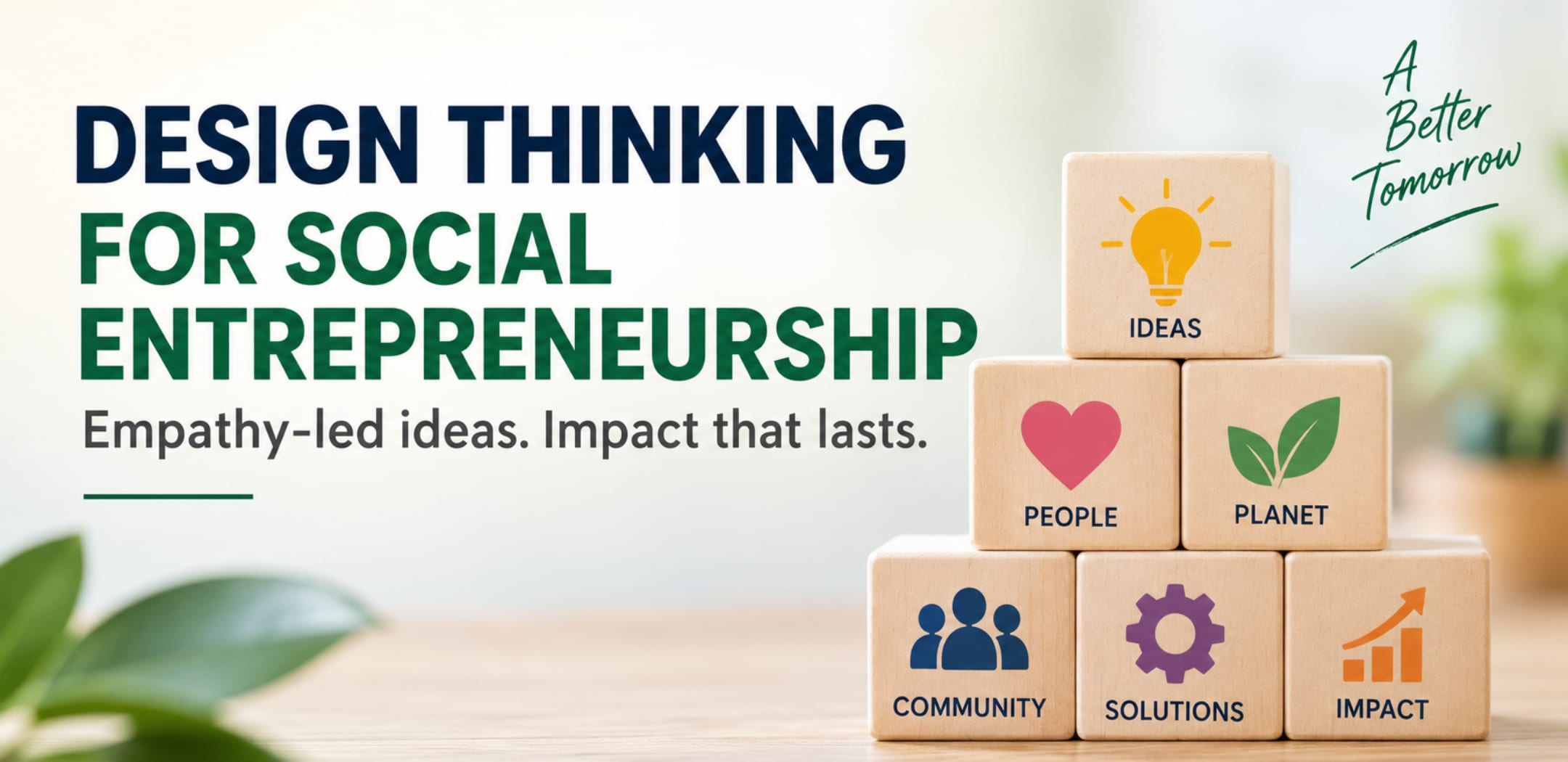
Design Thinking for Social Entrepreneurship: Building Impact with Empathy
Social entrepreneurship is not simply about identifying problems and creating solutions. It is about understanding people, communities, and systems deeply enough to create solutions that are meaningful, practical, and sustainable.
In a world shaped by complex social challenges, inequality, changing healthcare needs, sustainability concerns, and limited access to essential resources, Design Thinking offers social entrepreneurs a human-centered way to innovate.
For students and professionals in pharmacy, biotechnology, food technology, cosmetology, healthcare, and related disciplines, Design Thinking is more than an innovation methodology. It is a mindset that can help transform technical knowledge into purpose-driven products, services, and social ventures.
What Is Design Thinking in Social Entrepreneurship?
Design Thinking is a human-centered approach to problem-solving that begins with understanding the people affected by a particular challenge.
Instead of starting with assumptions about what communities need, social innovators use observation, conversations, research, experimentation, and feedback to develop solutions around real experiences.
The process commonly involves five interconnected stages:
Empathize – Understand users, communities, challenges, motivations, and lived experiences.
Define – Clearly identify the problem that needs to be addressed.
Ideate – Explore multiple possible approaches instead of immediately choosing one solution.
Prototype – Develop an early version of the product, service, programme, or intervention.
Test – Collect feedback, identify weaknesses, and continuously improve the solution.
For social entrepreneurs, these stages help reduce the risk of building solutions that appear promising on paper but fail to address the realities of the communities they are intended to serve.
Why Design Thinking Matters for Social Entrepreneurs
Social problems are rarely one-dimensional.
Challenges involving healthcare access, nutrition, education, sustainability, livelihoods, or community development are usually influenced by economic, cultural, behavioural, technological, and social factors.
Design Thinking encourages entrepreneurs to examine these factors before developing a solution.
Understand Underserved Communities More Deeply
Meaningful innovation begins with listening.
Interviews, field observations, community interactions, and stakeholder conversations can help innovators understand what people actually experience instead of relying entirely on assumptions or secondary information.
Co-Create Solutions With Real Users
People affected by a problem should not always be treated merely as beneficiaries.
They can become active participants in the innovation process.
Co-creation can reveal cultural preferences, usability issues, affordability concerns, behavioural barriers, and practical requirements that may otherwise remain unnoticed.
Prototype Ideas Quickly
Social entrepreneurs often operate with limited resources.
Rather than investing heavily in a fully developed solution immediately, Design Thinking encourages the creation of simple prototypes that can be tested early.
A prototype could be a basic product sample, mobile interface, service workflow, educational programme, packaging concept, or community intervention.
Improve Through Continuous Feedback
Successful social innovation is rarely created in a single attempt.
Testing and feedback allow entrepreneurs to identify weaknesses, refine the solution, and improve its relevance before attempting broader implementation or scale.
In this way, Design Thinking reminds us that impact begins with understanding before implementation.
Design Thinking Opportunities in Healthcare, Pharmacy and Life Sciences
Design Thinking can be particularly valuable for students and professionals working in science-driven disciplines.
A technically effective solution may still fail if it is difficult to understand, inaccessible, expensive, culturally inappropriate, or inconvenient for the intended user.
For example, Design Thinking could contribute to the development of:
- Patient-friendly healthcare services
- Affordable nutrition solutions
- Community health programmes
- Accessible pharmaceutical products
- Sustainable packaging
- Preventive healthcare initiatives
- Digital health tools
- Cosmeceutical products designed around specific consumer needs
- Educational tools for health awareness
- Community-based biotechnology solutions
The objective is not to replace scientific rigor but to combine it with a deeper understanding of human behaviour and real-world needs.
𝐒𝐤𝐢𝐥𝐥𝐬 𝐓𝐡𝐚𝐭 𝐌𝐚𝐭𝐭𝐞𝐫
To thrive in this space, professionals need empathy, cultural literacy, systems thinking, rapid prototyping, storytelling, emotional intelligence, and collaborative agility. Design Thinking turns intention into transformation. Beyond Teaching and BRC are where empathy meets enterprise—empowering students to build social ventures that heal, uplift, and endure.
Final Thought
Social entrepreneurship demands more than good intentions.
It requires the ability to understand people, question assumptions, experiment responsibly, learn from failure, and continuously improve.
Design Thinking encourages innovators to listen before they build, co-create before they scale, and understand the people behind every problem they hope to solve.
When empathy is combined with scientific knowledge, entrepreneurship, and thoughtful design, social innovation has a greater chance of creating solutions that do more than attract attention.
It can create impact that lasts.