Design Thinking for Innovation Management: A Future-Ready Skill
Innovation is no longer limited to R&D teams or product departments. Today, organisations need professionals who can understand problems, work across disciplines and create solutions that are useful, practical and relevant.
This is where Design Thinking plays an important role.
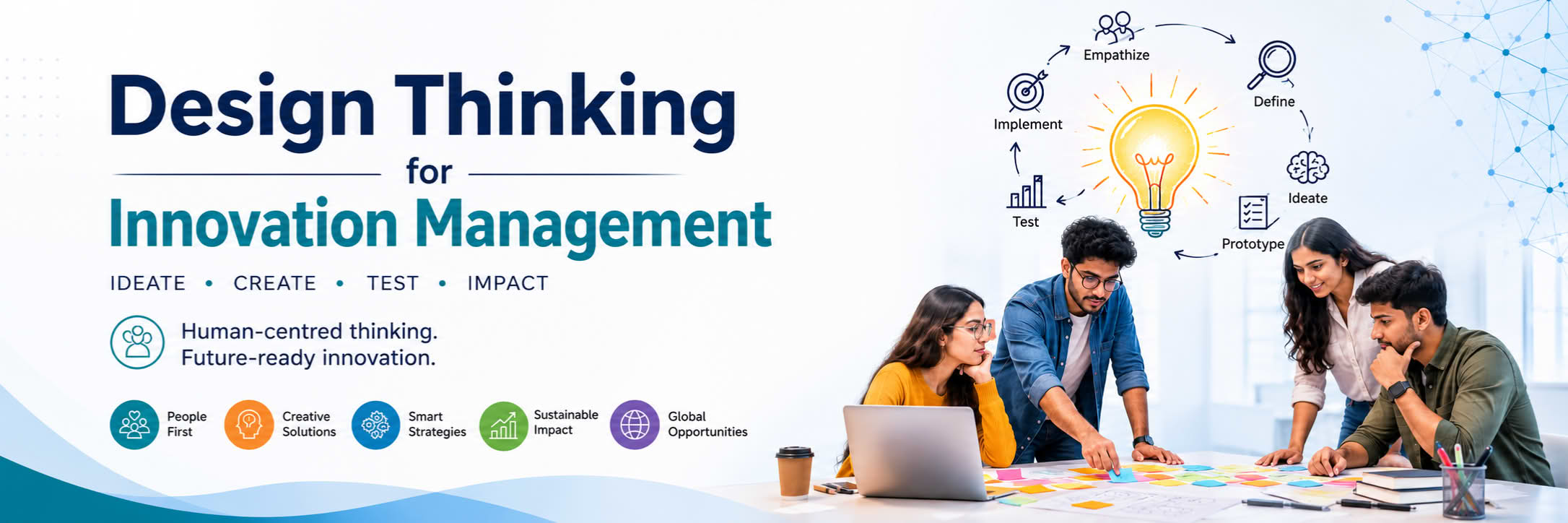
Design Thinking is a human-centred approach to problem-solving. It focuses on understanding users, identifying the real problem, exploring ideas, creating prototypes and improving solutions through testing and feedback.
For students and professionals in pharmacy, biotechnology, food technology, cosmetology and allied sciences, this approach can add a valuable dimension to technical knowledge.
Why Design Thinking Matters
A good innovation is not just technically strong. It should also solve a real problem.
Design Thinking helps teams look beyond assumptions and understand what people actually need.
It is increasingly useful in areas such as:
- Product development
- Customer experience
- Business model innovation
- Sustainability
- Healthcare and wellness
- FMCG and life sciences
For example, a food technologist may know how to develop a product, but Design Thinking encourages additional questions:
Who will use it? What problem does it solve? Is it convenient? How can the user experience be improved?
This combination of technical and human-centred thinking can lead to better innovation.
Skills That Matter
Design Thinking helps professionals strengthen important future-ready skills such as:
- Empathy and observation
- Problem-solving
- Systems thinking
- Creativity
- Rapid prototyping
- Collaboration
- Emotional intelligence
- Adaptability
These skills are valuable because modern industries increasingly require people who can work across technical, commercial and customer-focused roles.
Career Opportunities
Design Thinking can support career growth in roles such as:
- Innovation Manager
- Design Strategist
- Product Development Lead
- Service Designer
- Innovation Consultant
- Design Thinking Facilitator
These opportunities are relevant across industries including pharmaceuticals, nutraceuticals, cosmetics, biotechnology, healthcare, food and technology.
From Technical Knowledge to Innovation Thinking
Technical education teaches students how things work.
Design Thinking adds another important perspective:
Why should this solution exist, who needs it and how can it create better value?
This mindset can help students and professionals move beyond subject knowledge and become stronger problem-solvers, innovators and future leaders.
Platforms such as Beyond Teaching and Beyond Research encourage this broader approach by connecting learning with practical thinking, interdisciplinary collaboration and innovation.
The Future Needs Better Problem-Solvers
Design Thinking is not simply a process or a trend.
It is a way of thinking that encourages professionals to understand first, experiment quickly, learn from feedback and create solutions with purpose.
For students entering innovation-driven industries, developing this mindset can help connect science, creativity, business and real human needs.
Because meaningful innovation rarely begins with a product.
It begins with understanding.